Lately, I’ve been thinking a lot about time. Not the kind you schedule or squeeze in, but the kind that feels like a gift. Imagine being handed an extra ten hours each week. What would you do with it?
For me, recently, that answer wasn’t ambitious or productive. I didn’t want to learn something new or tick anything off a list. I just needed to sleep.
I’d been running on empty for months; juggling work, family, life, and putting myself last. And my body started to let me know. Another cold. Constant tiredness. That low‑level emotional drain that creeps in when you’re stretched too thin for too long.
So over the bank holiday, despite us initially having plans as a family, Clark (my partner) took my son River to his mum’s, and I stayed in bed. No alarms. No rush. Just rest.
But I realised I could only truly relax because the washing was done, folded and put away.
It wasn’t sitting on the spare bed like it usually does, that familiar pile that somehow takes up space in my head as well as the room. That small detail gave me permission to rest.
That weekend, I used a few more of those reclaimed hours for myself. A coffee on my own. A rare but oh so needed self care day. Nails done. A massage. Simple things, but restorative ones. Time that helped me come back to myself. And it made me realise something quite important.
The slow drain of a home that doesn’t quite work
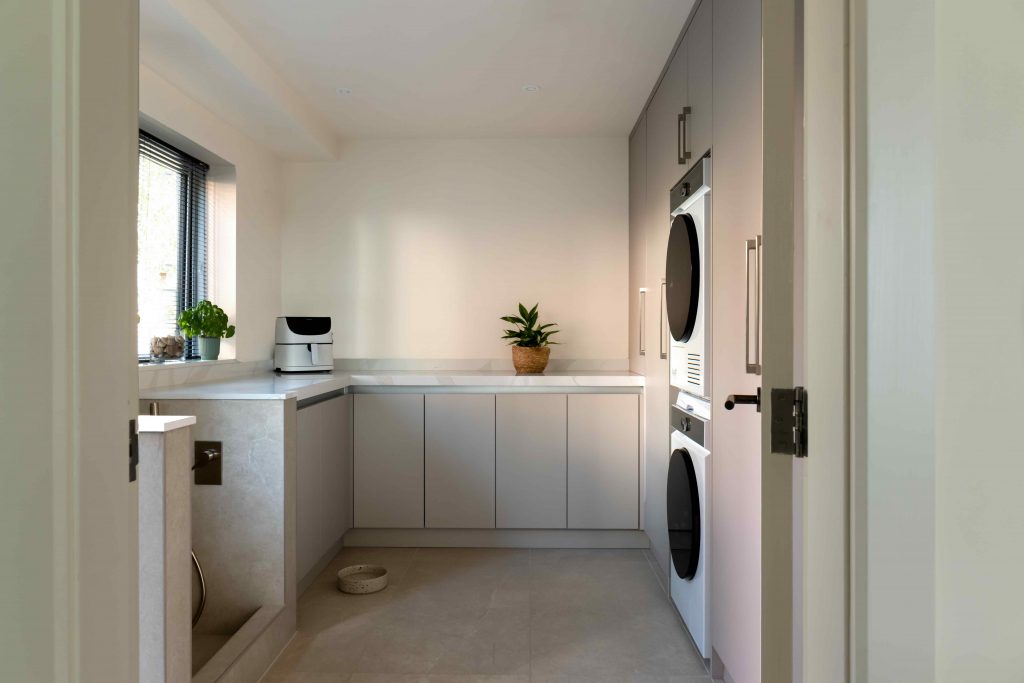
The reason the washing usually feels so heavy isn’t the washing itself. It’s the effort around it. The back and forth. The lack of flow. The fact that it never has a proper home. And I started thinking, if my home were planned just a little differently, and if we had a dedicated utility space with carefully curated storage, how much easier would that task be each week? How much time would it give back to me? And then a whole other stream of thought nagged at me, that our house just isn’t big enough for our needs as family of three and we now need to upsize (but that’s a story for another day!).
Usually with interiors, the initial thinking is to talk about finishes and colours and furniture.
But rarely about how a space either supports your energy… or slowly drains it.
A well‑designed home doesn’t just look good. It reduces frustration.
It makes everyday tasks lighter. It removes decision fatigue. It helps things happen more intuitively. And more importantly, it gifts you time. That’s where the real luxury lives.
Even as a designer, I find it hard
I’ll be honest, even as an interior designer, someone with the skills, years of experience and knowledge; I find it incredibly hard to carve out the time and mental space to properly design my own home.
Because good design takes deep thinking. It takes time and it takes focus. And when you’re juggling a million other priorities, often being our clients homes, it’s always the thing that gets pushed to the bottom of the to-do list.
So rooms stay “nearly finished”. Decisions get delayed. Spaces work… but not optimally. And if I find it hard with all the tools and training, how must everyone else feel?
A message that made everything clear
A few days later, I received a voice note from an old school friend. Five years ago, she’d done an extension. At the time, she thought involving a designer would be unnecessary, after all, how hard could it be? They were her words, not mine!
Now, years on, she said she regretted not getting me involved sooner.
“Truth be told, I wouldn’t have done the extension the way I did it, if I was to do it again, I just don’t think I’m doing it justice”
” I didn’t think I’d have a problem doing these things but then you realise, no this is actually really hard”
“Even when everything is tidy, I just don’t like it and I can’t put my finger on why.”
As she talked, her frustration bubbled over, fumbling through everything she disliked about the space, then suddenly stopping to shout out because she’d just stood on a toy. It was such a reality moment.
Exhausted and time stretched with two energetic young boys fighting for her attention every second of every day. Trying to solve something complex in the cracks of an already full life.
It’s not about taste. It’s about time.
Most people do have design instinct. They have taste. They know what they like and dislike. The problem often isn’t a lack of ability. The problem is time.
Time to think strategically. Time to step back and see the bigger picture. Time to consider flow, storage, light, proportion and how a space will actually be used day to day.
Instead, decisions get made in spare five‑minute windows at the end of long days. Once the kids are finally asleep. When you’re tired, depleted, and just want something decided.
That’s when impulse decisions happen. That’s when things look fine individually, but don’t quite come together as a whole. And that’s not a failure, it’s human. It’s just not the right environment for well considered design.
What a designer really gives you
Hiring a designer isn’t about outsourcing style and taste. It’s about outsourcing the mental load. It’s about having someone hold the vision when you don’t have the capacity to. Someone who can think clearly, calmly and strategically on your behalf. Someone who can design your home not just to look beautiful, but to work harder for you.
To save you time, to reduce frustrations and to support your energy rather than drain it. In that sense, design becomes deeply practical and actually quite generous.
It gifts you back hours you didn’t realise you were losing.
Time, reclaimed
When we talk about luxury in interiors, it’s often framed as something visual or material. But perhaps the greatest luxury a home can offer is time.
Time to rest. Time to breathe. Time to enjoy the life happening within it.
And sometimes, allowing someone else to help design that, to think deeply so you don’t have to, is not indulgent at all, and it’s not a failure. For many of us, it’s exactly what we need.
If this blog resonates with you, then please get in touch, and let us know what is currently draining your time and energy within your home. We’d love to help give you some time back!
Natalie x